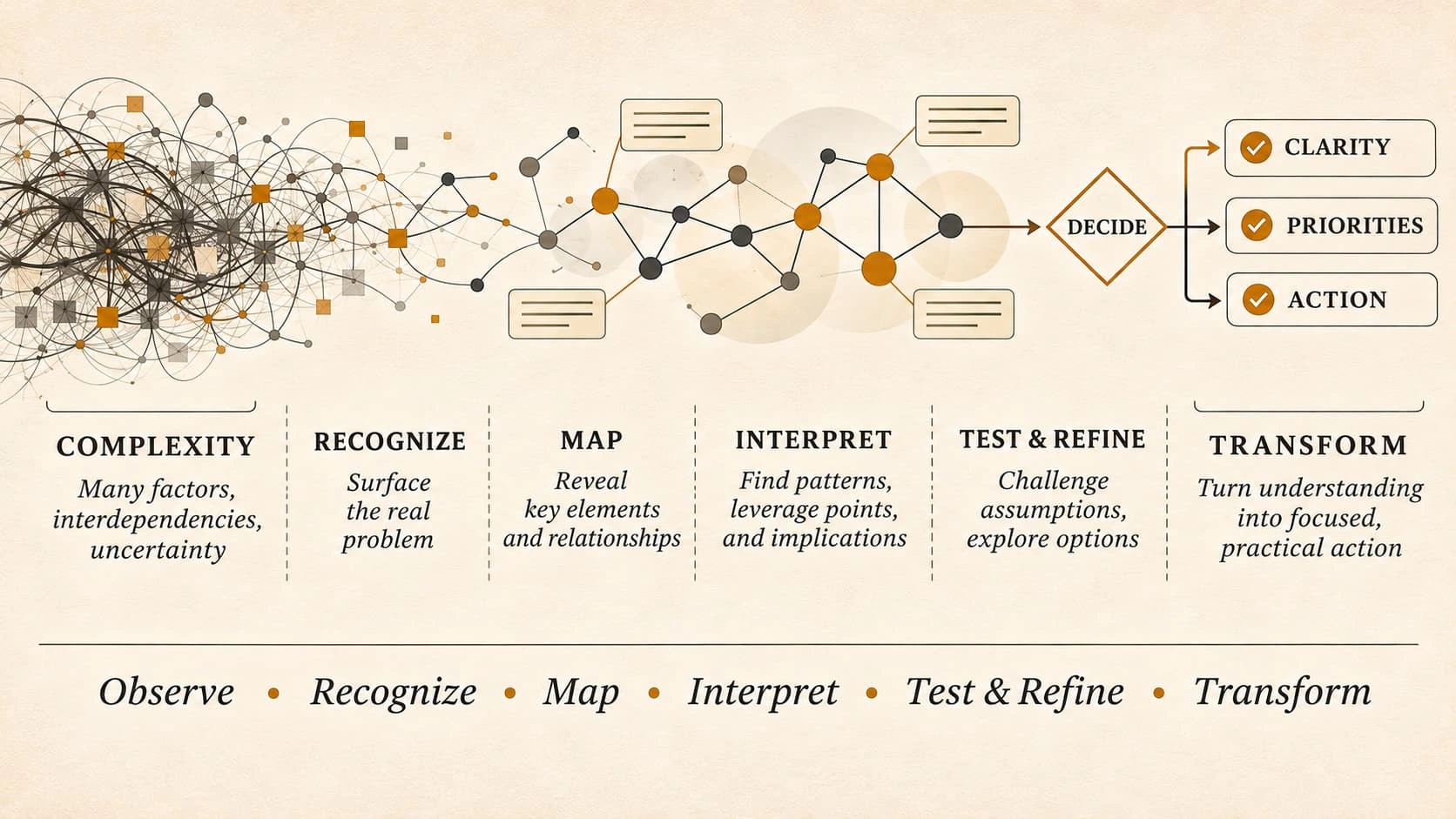
Introduction — Before You Solve It, Make Sure You Understand It
Imagine a company with a problem that should be easy to explain.
Sales are growing. The team is working harder than ever. Yet cash is getting tighter, customers are waiting longer, and everyone seems to have a different idea of what to fix.
The sales manager wants more leads. Finance wants tighter spending. Operations says the company is making too many promises. Each person has numbers to support their position.
The founder has a dashboard, a detailed report, notes from three meetings, and an AI-generated summary. There is no shortage of information. But there is still no shared understanding of what is happening.
This is where many expensive decisions begin.
We are used to treating problems as questions that need answers. So we look for more data, ask more people, or search for a faster recommendation. Sometimes that works. But in a complex situation, the first useful move may be to change the question.
Instead of Which recommendation should we follow?, ask:
How are these things connected, what are we assuming, and what would we need to learn before making a bigger move?
The difference matters. A quick answer can help you act. A better understanding can help you avoid acting on the wrong problem.
This guide offers a practical way to work with that difference. It is not about drawing beautiful diagrams, making every decision slowly, or turning ordinary business problems into scientific projects. It is about taking the information already in front of you and working with it more carefully—until you can see a useful next step, and explain why that step makes sense.
Part I — Understanding the Challenge
01. Why More Information Doesn't Mean Better Understanding
A growing business produces more information almost by default. More customers mean more feedback. More employees mean more opinions. More tools mean more reports, alerts, forecasts, and conversations.
That can be useful. It can also make a problem harder to see.
Take the company from our opening example. The founder knows that revenue has increased and that cash is under pressure. Both observations may be correct. But those two numbers do not explain the relationship between them.
Maybe larger customers take longer to pay. Maybe growth requires more inventory or hiring before invoices are collected. Maybe the team is spending extra time delivering custom work. Or perhaps the cash problem comes from something entirely different.
These are possible explanations, not findings. The data does not choose between them for us.
The temptation is to select the explanation that sounds most familiar. Sales sees a sales problem. Finance sees a financial problem. Operations sees a delivery problem. Nobody has to be careless or dishonest for this to happen. Each person is looking at a different part of the same business.
A founder's job is not to dismiss those perspectives. It is to understand how much of the situation each one explains—and where the gaps remain.
AI makes this challenge more interesting. You can now turn a long report into a clear summary in seconds, ask for ten possible causes, or generate an action plan before the next meeting. Those are useful capabilities. But a convincing answer is still built from the information and assumptions available to it. If important context is missing, the answer may be well written and still point in the wrong direction.
That does not mean you should stop using AI, dashboards, or expert advice. It means you should know which job you are asking each of them to do.
A dashboard can tell you that something changed. A specialist can explain what they know from experience. An AI tool can help organize possibilities. None of these, by itself, guarantees that you have identified the problem that needs your attention.
There is also a danger in the opposite direction: endless analysis. Not every decision needs a workshop, a diagram, or another report. If the issue is clear and the next step is low-risk, act.
The challenge is knowing when a situation is simple enough to move quickly—and when a quick answer would only hide the complexity.
Try this before your next important decision. Write one sentence:
We believe the main problem is ______ because ______. We would reconsider that explanation if we discovered ______.
If you cannot fill in the last part, you may be more attached to your explanation than you realize.
The purpose is not to make you doubt everything. It is to make your confidence useful.
02. The Difference Between Collecting Information and Thinking With It
Most of us are quite good at collecting information.
We take notes during meetings, save messages, record conversations, build spreadsheets, and ask AI to summarize long documents. At the end of the day, we may have an impressive record of what happened.
But a complete record is not necessarily a useful picture.
Meeting notes tend to follow the order in which people speak. Business problems rarely follow that order. Someone mentions a customer complaint, another person talks about workload, and ten minutes later somebody raises a pricing issue. In the notes, these are three separate moments. In the business, they may be connected.
That is the difference I am interested in.
Across more than 500 interviews with entrepreneurs and specialists, alongside my work in business and coaching, I have developed a habit of drawing rough maps while people talk. They are not presentation slides. They often look untidy. Their value is not in capturing every sentence but in helping me notice relationships, missing links, and questions I would otherwise overlook.
Sometimes a new connection changes what I ask next. Sometimes a gap in the map is more interesting than everything already written on it. The map becomes a working surface for thinking, not just a record of what I heard.
You can use the same principle without being an interviewer or knowing anything about mind mapping.
Return to the company with growing sales and shrinking cash. On a sheet of paper, put the question in the center:
Why is cash getting tighter while sales are growing?
Around it, place the things you actually know: revenue has increased; some customers pay after delivery; the team is working longer hours; certain projects have missed their target dates.
Now start asking about relationships.
Are delayed projects also being invoiced later? Are the longer hours tied to particular kinds of customer work? Have payment terms changed? Is the pressure coming from one large customer or from the business as a whole?
Do not draw an arrow because two facts appear on the same page. Draw a possible connection because it is worth investigating, and put a question mark beside it until you have evidence.
A simple page can now show something your meeting notes did not: several competing explanations, the information missing from each, and the next question that could help you distinguish between them.
It is important not to fall in love with the drawing. A map can make a weak theory look convincing. Its neatness does not make an assumed connection true. If a new fact contradicts your picture, change the picture.
This is why the process matters more than the format. You can use paper, a whiteboard, sticky notes, or software. The point is to move from storing statements to examining how they might fit together.
Try a small experiment. After your next difficult meeting, choose four important statements from your notes. Put them on one page. Connect the ones that may be related, mark every uncertain connection with a question mark, and ask:
Which of these connections, if it turns out to be wrong, would most change our next decision?
That question may be more useful than another page of notes.
And it leads us to the next part of this guide: a practical way to observe a situation, recognize the problem, map its relationships, interpret what emerges, test our assumptions, and turn the result into action—without pretending that the steps always happen in a straight line.
Part II — The Six-Step Practical Model
You don't need a complicated system to think more clearly. You need a way to keep important information from getting mixed up too early.
The six steps that follow are a practical working model. They are not a formula that guarantees the right answer, and you won't always use them in the same order. Sometimes a new fact will send you back to the beginning. Sometimes you will recognize enough to make a small decision without completing the entire process.
Let's return to the company where sales are growing, cash is getting tighter, and every department has a different explanation.
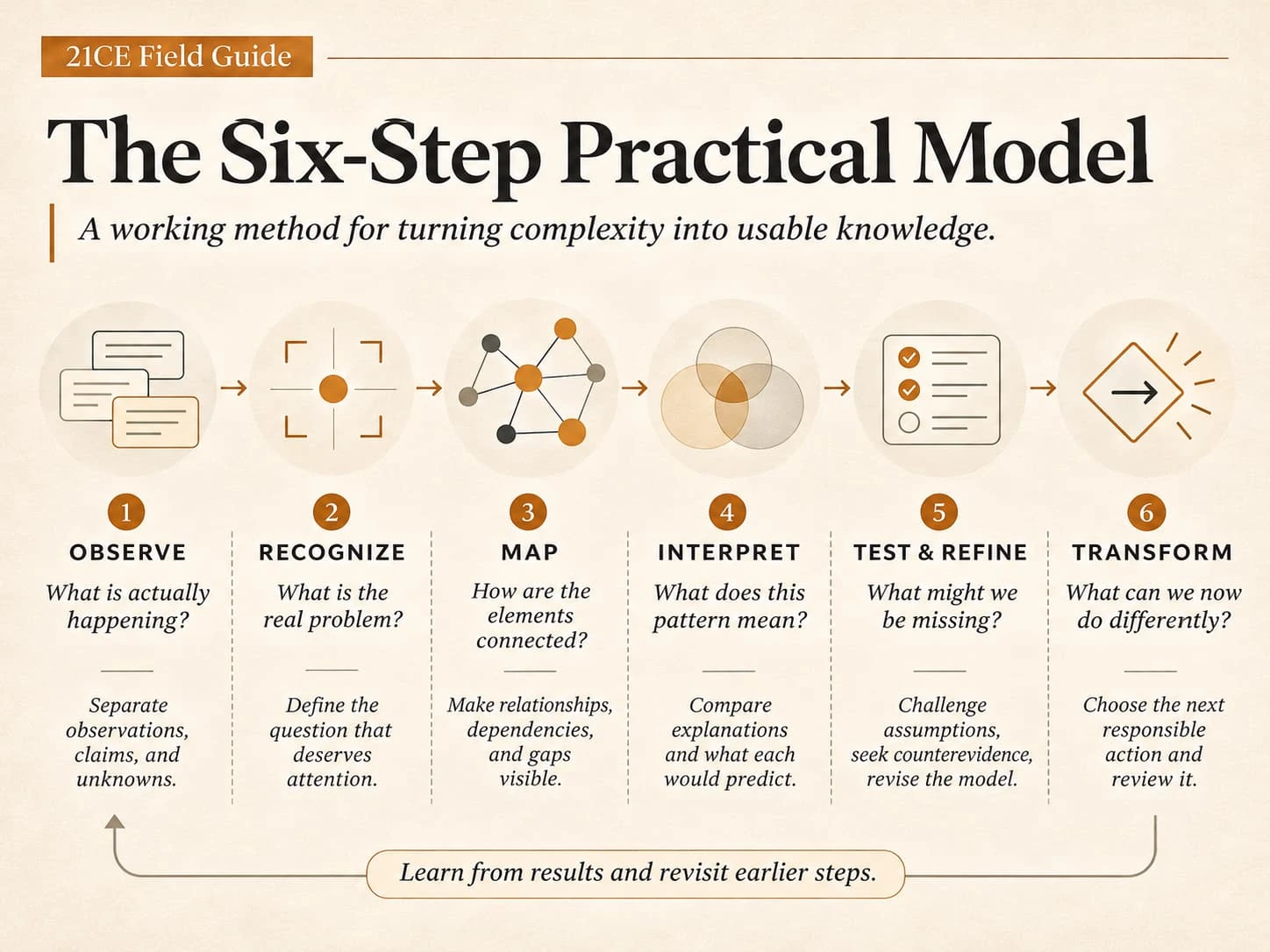
03. Observe — What Is Actually Happening?
Picture the next management meeting.
Someone says, “Our sales team is bringing in the wrong customers.” Another person replies, “No, we're just delivering too slowly.” Within minutes, the group is discussing hiring, pricing, and whether to replace the sales process.
It feels productive. People have ideas. But they have moved from describing the situation to proposing solutions without checking what they actually know.
Observation is where we interrupt that jump.
Start with what can be established. Revenue has increased over a defined period. The available cash balance has fallen. Some deliveries are late. Customers have complained about waiting. These are different observations, drawn from different sources. Even when they are all accurate, they don't yet tell us why they are happening together.
Now look at the statements made in the meeting.
“Customers don't pay quickly enough” might be supported by invoice and payment records. Or it might be a conclusion formed after two frustrating collections calls.
“We need more people” may be a reasonable concern from an overloaded team. But it is still a proposed explanation until we understand the workload, the type of work, and where time is being lost.
The distinction is simple: record what happened, who is saying what, and what is still unknown. Don't treat those three things as interchangeable.
This doesn't require a formal investigation. A founder might spend ten minutes checking invoice dates, asking the delivery lead about delayed projects, and comparing the periods used in the sales and cash reports. The point is to make sure people are discussing the same situation, not different versions of it.
There is one more detail worth noticing: what you choose to observe depends on the question you are trying to answer. If the concern is cash, the timing of money entering and leaving the business matters. If the concern is customer trust, the pattern of promises and actual deliveries matters. Both perspectives may be necessary, but neither captures everything.
Good observation is not about collecting every possible fact. It is about getting enough reliable detail to avoid inventing a story too early.
Try this in your next difficult meeting. Before discussing solutions, ask everyone to finish two sentences:
What we have observed is ______. What we currently believe it means is ______.
If the answers sound identical, take another look. You may have a conclusion disguised as a fact.
04. Recognize — What Is the Real Problem?
Now imagine that the founder leaves the meeting with a perfectly accurate list of observations.
The business still needs a decision.
Should the company increase marketing? Change payment terms? Hire more people? Stop accepting certain projects?
This is where recognizing the problem becomes different from observing the situation.
“Our cash is running low” describes a condition. “We need more sales” proposes a solution. Neither necessarily identifies what needs to change.
A useful problem statement sits between them. It tells us what is going wrong, why it matters, and what we need to understand before committing resources.
For the company in our example, there are several plausible explanations.
Perhaps new business requires spending on people or materials long before customers pay. Perhaps some projects take longer than expected and delay invoicing. Perhaps margins are weaker than the headline sales figures suggest. Perhaps the timing of a major payment has created a temporary squeeze.
More than one of these could be true.
Instead of declaring a single root cause, the founder could frame a better working question:
What is causing the gap between growing sales and available cash, and which part of that gap can we change?
That question is useful because it directs attention toward relationships that can be checked. It also keeps the team from treating the first proposed remedy as an established answer.
But we can make it more practical still.
What decisions are actually waiting for us? How much time do we have? What would happen if we chose the wrong explanation? Which unknown could change our decision most?
A company facing payroll next week cannot run a three-month study before acting. It may need to secure short-term cash while continuing to investigate what created the pressure. Immediate protection and better diagnosis can happen together.
This is an important point: recognizing a problem doesn't mean finding one perfect sentence that explains everything. Complex situations often contain several connected problems, with different levels of urgency.
The aim is to choose a problem definition that helps you decide what to examine, what to protect, and what not to assume.
A weak definition invites automatic solutions: Cash is tight, so we need to sell more.
A stronger one creates a useful test: We need to understand whether growing sales are creating a payment-timing problem, a delivery-cost problem, or something else.
The second version does not make the decision for you. It makes the next investigation more intelligent.
Try this with one problem you're facing. Write your current problem statement, then ask:
Am I describing what is happening, guessing why it is happening, or already recommending what to do?
Rewrite it so that someone who disagrees with your preferred solution could still help investigate the problem.
That is often the first sign that the question is becoming useful.
05. Map — How Are the Elements Connected?
We now have observations and a better question. But the business is still not a tidy collection of separate issues.
Sales promises affect delivery. Delivery affects when work is completed. Contract terms affect when invoices can be issued and when customers must pay. Hiring and materials may require cash before those payments arrive.
A written list can capture each element. A map helps you work with the relationships between them.
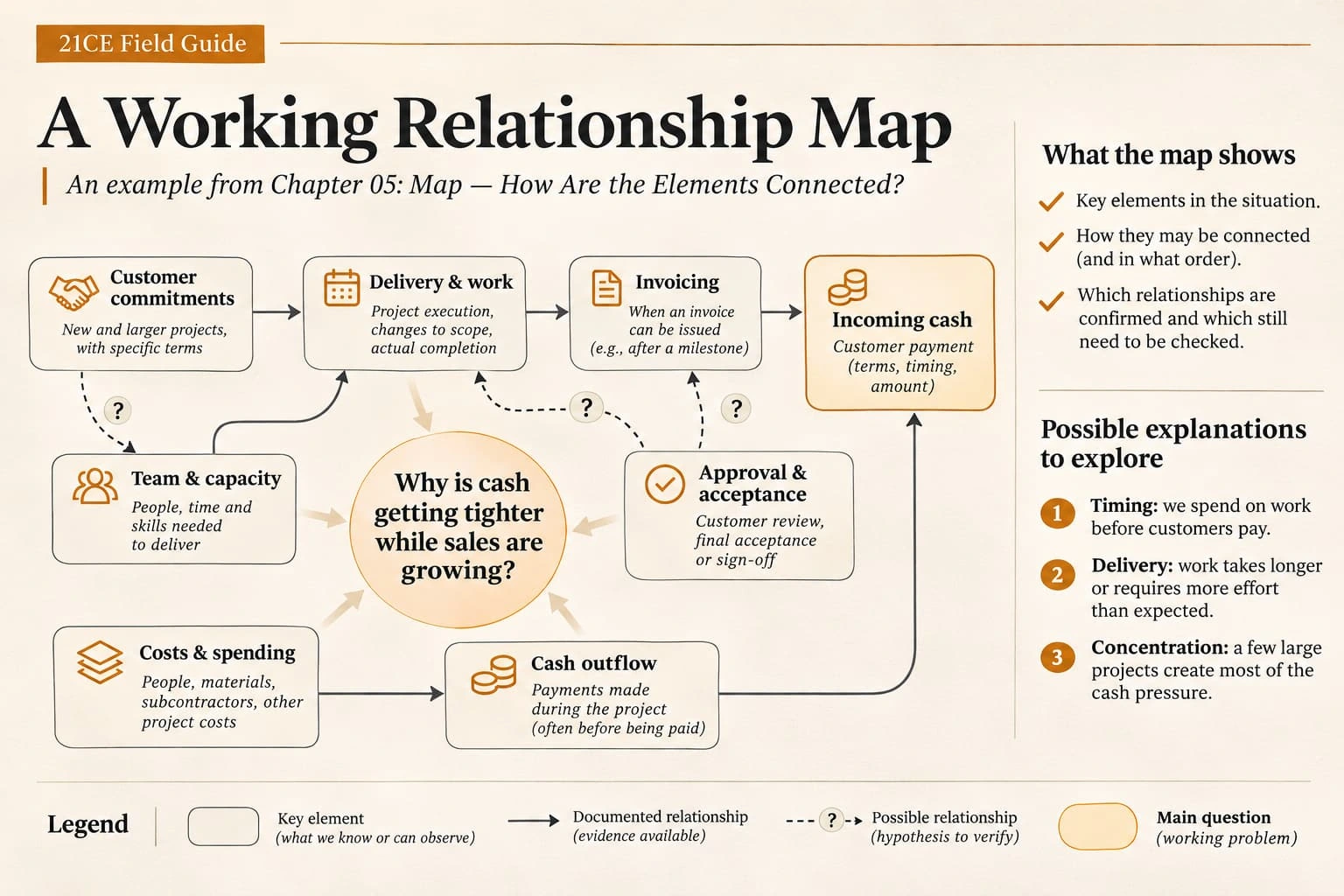
Take a blank page and write the question in the center:
Why is cash getting tighter while sales are growing?
On the left, place customer commitments and payment terms. Near the middle, put delivery work, scope changes, and project milestones. On the right, put invoicing and incoming payments. Below them, add costs that must be paid along the way.
There is no magic in these positions. They simply help you see the movement of work, obligations, and money.
Now connect the elements. Label each line with what you think the relationship is.
For example, a contract may make invoicing dependent on completing a milestone. If so, a delivery delay could also delay the invoice. That is a connection worth checking against the actual contract and project record.
But don't draw a line from “late delivery” to “cash shortage” and treat it as proven. The cash problem might be driven by something else. Mark uncertain connections with a question mark. Keep alternatives visible.
Time belongs on the page too. A business can be profitable on paper and still face a cash problem when expenses must be paid weeks before customers settle their invoices. Dates and sequences may explain more than a larger pile of figures.
You may also notice a possible feedback loop. Extra promises could create delivery pressure. Delays could generate rework and customer complaints. Rework could consume time needed for other projects, creating even more pressure.
That is a hypothesis to investigate, not a story to accept because it looks convincing in a diagram.
As the picture develops, something useful happens: the team can stop arguing only about departmental opinions and start examining specific connections.
Finance can ask whether certain projects are invoiced later than expected. Operations can check whether changes to scope account for delays. Sales can examine what was actually promised and whether the contracts reflect it.
The map gives them a common surface for asking better questions.
But a map can be wrong. A clear drawing is not the same as a true explanation. If you leave out a critical customer, confuse sequence with causation, or give an assumption the same status as a verified fact, the map may make your decision worse.
The goal is not to include every detail. It is to preserve the relationships that matter for the decision, while keeping uncertainty visible.
Try this on one sheet of paper. Put your current problem in the center. Add six to ten elements that may influence it. Draw the most important connections, mark the uncertain ones, and circle the single connection you would most like to verify.
Then ask:
If this connection is not real, how much of our explanation would have to change?
A good map does not finish the thinking. It helps you see where the thinking needs to go next.
In the next step, we'll look at what these patterns might mean—and how to avoid confusing an interesting connection with a reliable conclusion.
06. Interpret — What Does This Pattern Mean?
A map can show you where information meets. It cannot tell you, on its own, what those connections mean.
In our example, the founder can now see the relationship between sales commitments, delivery work, invoicing, and available cash. Several lines on the page look important. But which ones explain the problem?
There may be more than one answer.
One possibility is timing. The company takes on new work and pays people or suppliers before customers pay their invoices. Growing sales could therefore increase the amount of cash needed to keep operating.
Another possibility is cost. The company may be winning work that takes more time to deliver than expected. Revenue grows, but the work leaves less money behind.
A third possibility is concentration. A few large projects might account for much of the outstanding cash. The overall business looks healthy until one delayed payment creates pressure.
All three explanations could fit parts of the map. None becomes true simply because it sounds reasonable.
This is where interpretation starts: not by choosing the story you like best, but by asking what each possible story would lead you to expect.
If payment timing is the main issue, you would expect to find a meaningful gap between when the company spends money on a project and when it receives payment.
If delivery costs are the main issue, you would expect to see projects consuming more time or resources than the estimates allowed.
If the problem is concentrated in a few accounts, you would expect a small number of customers or projects to explain an unusually large part of the shortfall.
These expectations give the founder something useful: a way to distinguish between explanations rather than argue about them.
Interpretation also means deciding what matters for the next decision. A late invoice for a small project may be irritating but not important. An approval clause that delays billing across many projects may be much more significant. The size, timing, and consequences of each connection matter.
And this is where a single business problem can teach something more general.
For example, growth can put pressure on cash when spending rises before payments arrive. That lesson may be useful well beyond our fictional company. But it applies only under relevant conditions. It would be a mistake to conclude that growing businesses always face the same cash problem.
Useful knowledge is not just a memorable phrase. It is an idea you understand well enough to know when it might apply—and when it might not.
Try this with your own map. Choose the connection you circled in the previous exercise. Finish these sentences:
One possible explanation is ______. If that explanation is right, we should also see ______. A different explanation could be ______.
If you cannot say what you would expect to observe, your explanation may be too vague to help you decide.
07. Test & Refine — What Might We Be Missing?
Once we have a plausible explanation, we face a new problem: we may become too comfortable with it.
Imagine the founder is convinced that late customer payments are the main cause of the cash shortage. It seems to fit the numbers, and Finance agrees. The team begins discussing tougher collection procedures.
Before changing the process, someone asks a different question:
Are customers actually paying late—or are we sending their invoices later than planned?
That one question could change the direction of the investigation.
Suppose the company agrees to invoice some projects after a delivery milestone is accepted. If acceptance takes longer than expected, the invoice might be issued later even when the customer pays on time.
The original complaint—“Customers are too slow to pay”—would not describe the whole problem.
How could the team check?
It could examine a small, clearly chosen set of recent projects, including those delivered on time and those delayed. For each project, it could compare the agreed milestone, actual completion, customer acceptance, invoice date, due date, payment date, and work required beyond the original scope.
That exercise would not prove a general cause by itself. But it could reveal whether the current explanation deserves more confidence—or whether another part of the process needs attention.
There is an important human side to this step.
The questions we ask can influence the answers we receive. “Why does Sales keep promising impossible deadlines?” invites people to defend themselves. “What changed between the original proposal and the final delivery?” gives the team a better chance to describe what happened.
Neither question guarantees the truth. But one is more likely to keep an investigation open.
Ask people who see different parts of the situation to challenge the map. Not to vote on the best-looking explanation, but to identify missing information, incorrect connections, and cases that don't fit.
A colleague who can show that several delayed projects were billed on time may be more useful than five colleagues who agree with your original theory.
Feedback is valuable when it can change the model, not merely confirm it.
The same applies when you use AI. Ask it for alternative explanations and possible missing information, but don't treat a generated counterargument as evidence. Check important claims against the business records and people who can verify them.
When new information arrives, revise the map. Remove connections that don't hold. Add relationships you missed. If the problem statement no longer fits, rewrite it.
And don't feel obliged to keep investigating forever. The amount of checking should match the size and reversibility of the decision. A minor change can be tested quickly. A major investment, legal commitment, or decision affecting employees deserves more care.
Try this before accepting your preferred explanation. Ask:
What would have to be true for us to be wrong? Who or what could help us find out?
Then look for an answer that could genuinely change your mind.
08. Transform — What Can We Now Do Differently?
The founder has spent time gathering observations, defining the problem, mapping relationships, interpreting them, and checking the most important assumptions.
Now comes the test of whether that work was useful.
What will the company do differently?
A clear explanation is valuable, but it is not the same as a decision. A decision is not the same as action. And action does not automatically mean the problem has improved.
Start by separating two kinds of work.
The first is what cannot wait. If the company may struggle to meet payroll or supplier obligations, it needs an immediate cash plan. That may require reviewing the near-term forecast, contacting appropriate financial advisers or lenders, negotiating feasible arrangements, and making difficult choices with the information available. The company cannot postpone these obligations until every relationship on the map is understood.
The second is what will help prevent the problem from repeating.
Suppose the review suggests that some projects are invoiced later because completion and customer acceptance take longer than planned. The team might decide to examine milestone definitions earlier in the sales process, improve the handover between Sales and Operations, or test a different billing arrangement on suitable new projects, with the necessary commercial and legal checks.
Notice the difference: these are actions aimed at a particular suspected mechanism, not generic instructions to “improve cash flow.”
The team also needs a way to learn whether its chosen action helps.
If it changes the handover process, what should improve? Fewer unexpected scope changes? Faster milestone approval? A shorter delay between completing work and issuing an invoice?
Choose an outcome that is relevant, record the starting point, and agree when to review it. If the measure improves, that is encouraging—but other changes may have contributed. If it does not improve, the team should be ready to revisit the explanation.
This is where I find a short decision record more useful than another long meeting summary.
You can write it in a few lines:
We know ______.
We currently believe ______, but still need to check ______.
We will do ______. The responsible person is ______.
We will review ______ on ______.
We will reconsider our approach if ______.
The record makes the reasoning visible. It also gives people a way to disagree constructively: they can challenge the evidence, the interpretation, the action, or the way the outcome will be checked.
Sometimes the most responsible next step will be to run a small test. Sometimes it will be to involve someone with expertise the team does not have. Sometimes it will be to stop an activity that no longer makes sense. And sometimes the right decision is to wait for specific missing information—provided the cost of waiting has been considered.
The purpose of understanding complexity is not to eliminate uncertainty. It is to make better decisions while knowing what remains uncertain.
Try this now. Take the problem you've been working on through this guide and write one action you can responsibly take, one result you will watch, and one date when you will review what happened.
You don't need to resolve the whole situation today. You need a next move that makes sense—and a way to learn from it.
That brings us to a final, important point: these six steps are not a straight road from a problem to a solution. The result of one decision may change the map, reveal a different problem, or send you back to an earlier question. That is not a failure of the process. It is how the process stays useful over time.
Part III — Making the Model Work
The six steps are easy to describe on a page. Real situations rarely unfold so neatly.
People disagree. New information arrives halfway through a decision. A change that solves one problem may create another. And sometimes you need to act before you have the full picture.
The value of the model is not that it removes these difficulties. It gives you a way to keep learning while you work.
09. The Feedback Loop — Why the Process Is Not Linear
Let's return once more to the company with growing sales and shrinking cash.
Suppose the team reviews its contracts and project records. It finds that some invoices are delayed because customer acceptance takes longer than planned. The founder decides to test a clearer handover and milestone-review process on a limited number of new projects.
Two weeks later, the team looks at what happened.
Maybe those projects are moving through approval faster, but the cash forecast has barely improved. That doesn't necessarily mean the test failed. The projects may be too small to affect cash yet, or other payments may have changed. It also doesn't mean the original theory was complete.
The next question is not simply, Did we succeed?
It is: What did the result teach us about the problem?
The team may discover that project delays are only one part of the picture. Perhaps the largest cash requirement comes from work that must be paid for before delivery. That finding sends the team back to its map and changes what deserves attention.
This is a feedback loop in practical terms: you observe, interpret, act, look at the consequences, and update your understanding.
It works in both directions. A decision changes the situation, and the changed situation gives you new information for the next decision.
There is another kind of feedback worth paying attention to: your own.
If you were the person who proposed the original solution, you may be tempted to explain away an unexpected result. If a senior manager strongly supports your interpretation, the rest of the team may hesitate to challenge it. The quality of the review depends partly on whether people are genuinely allowed to say, “Our first explanation may have been wrong.”
That doesn't require endless meetings. Before an action begins, agree on what you expect to see, when you will review it, and what would cause you to change course. A small, reversible decision may need only a brief check. A major commitment deserves a more deliberate review.
And there is a time to stop analyzing. If the evidence is good enough for the size of the decision, the risk is manageable, and you know what to watch next, move.
Try this after your next important decision. Ask three questions: What changed? What did we expect? What do we now understand differently?
If the answer to the last question is “nothing,” check whether you actually reviewed the result—or only reported it.
10. Three Situations, One Method
The cash-flow example has carried us through the model. But the same approach can help with very different problems.
Here are three fictional business situations. They are illustrations of how to use the method, not case studies or evidence of guaranteed results.
A business that stopped growing
A small service company has reached a revenue plateau. The founder believes the market is saturated and wants to launch an expensive advertising campaign.
First, the team checks what is actually happening. Is the number of leads falling? Are fewer prospects buying? Are existing customers staying for less time? Or is there simply a limit to the number of projects the company can deliver?
The problem may need a different name. Instead of “We need more demand,” it could become “We don't yet know which part of our growth process has stopped working.”
The team maps customer inquiries, sales conversations, conversion, delivery capacity, repeat purchases, and referrals. It considers several explanations rather than choosing one.
Perhaps existing customers are satisfied but rarely return because there is no suitable next service. Perhaps inquiries are healthy, but the company cannot respond quickly enough. Both possibilities suggest different actions.
Rather than spend the full advertising budget immediately, the founder can check recent customer behavior and test one focused change. The useful result is not necessarily renewed growth within a week. It is a more informed choice about where to invest.
A team that keeps missing deadlines
Every project meeting ends with another promise to improve productivity. The manager believes people need to work with more discipline.
But when the team looks at recent projects, the missed dates cluster around work that needs approval from several departments.
The team recognizes that “People are not productive enough” may be a poor description of the problem. It draws a map showing decisions, handovers, dependencies, and the points where work waits.
One possible interpretation is that the bottleneck is not the amount of work completed, but how long decisions remain unresolved.
The manager asks different people to challenge that explanation. Some delays may come from incomplete requirements or realistic capacity limits rather than approvals. A short trial could give one clearly defined decision to a responsible owner while tracking turnaround time and rework.
If delays improve, the team has learned something worth examining further. If they don't, the map needs another revision. Either outcome is more useful than telling everyone to “work harder.”
An important decision outside your expertise
An entrepreneur is choosing a technology provider that will handle sensitive business and customer information. The proposals are impressive, prices vary, and every salesperson says their solution is secure.
The entrepreneur can compare features and prices, but doesn't have the technical or legal expertise to verify all the claims.
The first task is to separate verified requirements from vendor statements. Next comes a better problem definition: What risks and obligations must this decision address, and which parts can't we assess ourselves?
A simple map connects the information involved, the provider's responsibilities, the company's own responsibilities, access permissions, business continuity, and the consequences of failure.
The entrepreneur can identify questions for a qualified security specialist and legal adviser, ask vendors for relevant evidence, and compare answers against the actual use case.
The outcome may be a purchase, a limited pilot with suitable safeguards, or a decision to wait. The point is not that the method replaces expert judgment. It helps the entrepreneur recognize where that judgment is needed—and how to make better use of it.
Across all three situations, the six steps remain available. But the important connections, the evidence required, the urgency, and the next responsible action are different.
A useful method should adapt to the problem. The problem should not have to fit the method.
11. Your Next Complex Problem — A Practical Exercise
You don't need special software to begin. Set aside 25 minutes, take one sheet of paper, and choose a problem that matters to you.
It should be important enough to deserve thought but manageable enough that you can make one useful move. If the situation involves an urgent safety, legal, medical, or financial risk, take the necessary protective action and involve the right professionals; this exercise is not a reason to delay.
Keep the paper. It will become your first working record.
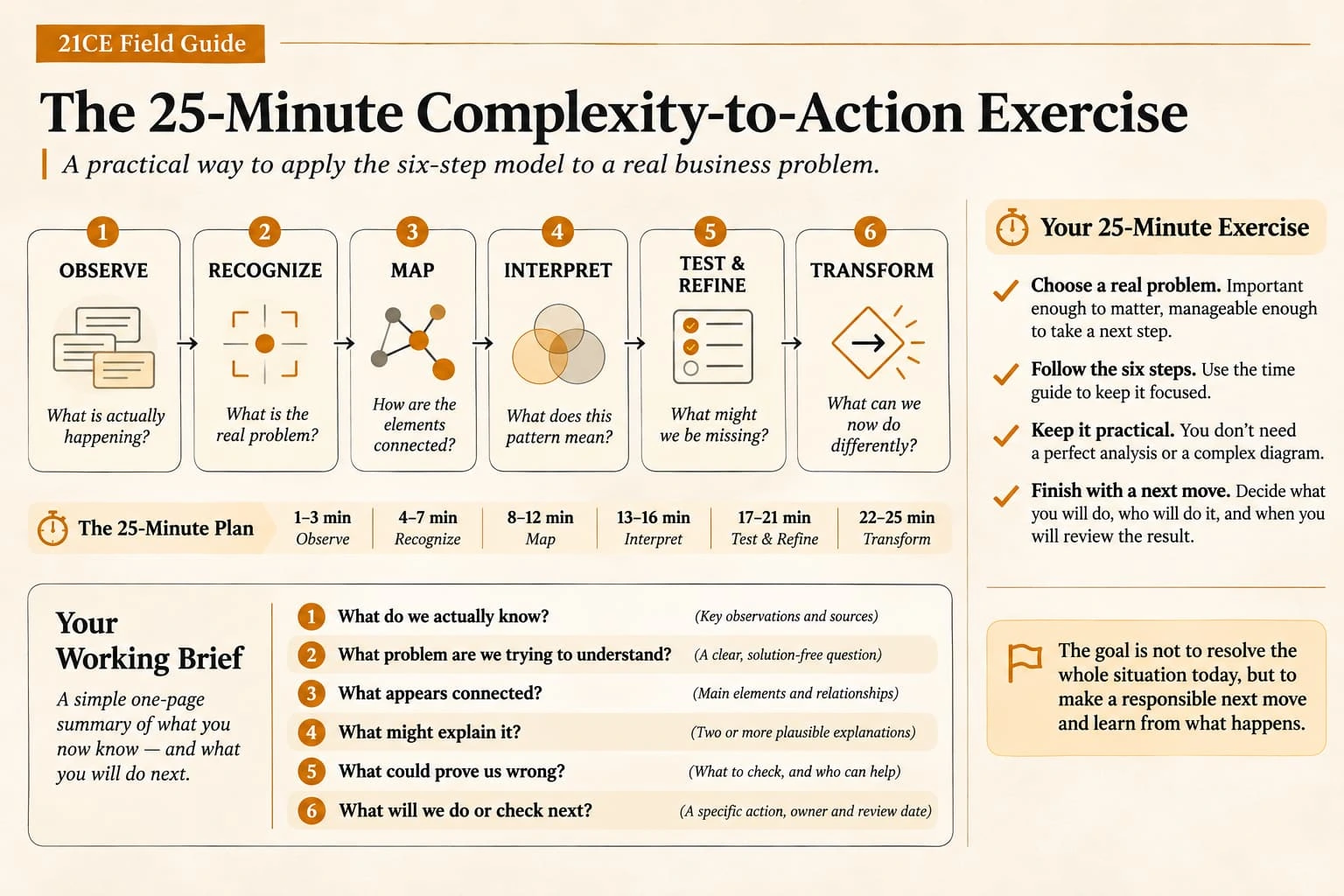
Minutes 1–3 — Observe
Write what you know has happened. Include numbers or dates if they matter. Next to each statement, mark whether it comes from a record you checked, something another person reported, or your own interpretation.
Leave space for what you don't know.
Minutes 4–7 — Recognize
Write the problem as you currently see it. Then remove any proposed solution from the sentence.
Ask yourself: What is going wrong, for whom, and which decision depends on understanding it?
If you have several problems, choose the one that matters most for your next decision. You can return to the others.
Minutes 8–12 — Map
Put that question in the middle of the page. Add the people, events, resources, decisions, constraints, and unknowns that appear relevant.
Connect related elements. Write a few words beside important lines to explain the relationship. Add a question mark when the connection is uncertain. Include time when the order of events matters.
Resist the urge to make the diagram beautiful.
Minutes 13–16 — Interpret
Find two possible explanations for the pattern you see.
For each, ask: If this were true, what else would I expect to find?
Highlight one missing fact or uncertain connection that could most change your next decision.
Minutes 17–21 — Test & Refine
Challenge your preferred explanation. Look for information that doesn't fit.
Ask: What would convince me that I'm wrong? Who could check this?
You may need another person's perspective or a piece of evidence you cannot get today. Write that down rather than filling the gap with a confident guess.
Minutes 22–25 — Transform
Choose one responsible next move. It might be a decision, a small test, a conversation with someone who knows more, or a pause while you gather essential evidence.
Write down who will do it, when, and what result or new information you will review.
Your page should now answer six plain questions:
- What do we actually know?
- What problem are we trying to understand?
- What appears connected?
- What might explain it?
- What could prove us wrong?
- What will we do or check next?
You may finish with more questions than you started with. That can be progress if those questions are sharper, more relevant, and easier to investigate.
Don't judge the exercise by how full the page looks. Judge it by whether you can now explain your next step—and what could make you revise it.
Conclusion — Better Questions Before Bigger Decisions
Most important business decisions don't arrive as neat problems with all the facts attached. They come through conversations, numbers, conflicting opinions, incomplete records, and pressure to move.
You can respond by gathering more information. Sometimes that's exactly what you need.
But there comes a point when another report, another opinion, or another AI summary won't help unless you change how you work with what you already have.
Observe what is happening. Recognize what needs to be understood. Map the relationships. Interpret the possible patterns. Test your assumptions. Take a responsible step—and return to the picture when the result teaches you something new.
You don't have to do this perfectly. You don't even have to draw a map every time. The habit worth developing is simpler: stay aware of the difference between what you know, what you think it means, and what you are ready to do about it.
Before your next difficult decision, give yourself one question:
Have I really understood the problem, or have I simply collected enough information to feel ready to act?